Saturday, December 20, 2008

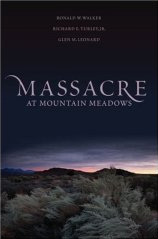
Book Review: Massacre at Mountain Meadows by Ronald W. Walker, Richard E. Turley, and Glen M. Leonard

“There is an unclean thing, born and nursed on our soil, polluting our soil, which must be driven away, not kept to destroy us.” Sophocles, Oedipus The King Act I

In the southwest corner of Utah, along Highway18, sits an alpine valley called the Mountain Meadows. It is a quiet place, out of the way from any major traffic. There are a few farms that sprawl across portions the valley but it is, by and large, undeveloped. At an altitude of nearly 6,000 feet the valley is a pleasant place to escape the summer heat that beats down on the surrounding dessert. In 1857 this valley was the scene of one of the most tragic events in the history of the West. That year a group of Mormon settlers disarmed a California-bound wagon train under a flag of truce and then systematically slaughtered approximately 120 men, women, and children.

For several years after the massacre fragments of clothing and the sun-bleached bones of victims lay strewn across the meadows, their shallow mass graves having been unearthed by coyotes. In southern Utah legends cropped up after the massacre about herds of wild cattle haunting the region surrounding the spot where their masters were slaughtered. Even the land itself seemed to bear a mark of guilt as a testament to the terrible crime that occurred there. In the two decades following the tragedy, natural erosion replaced the lush grasses of the meadows with scrub oak and sage, carved deep gullies across the fields, and turned the little rivulet that ran through the valley into a wide arroyo. Even the natural spring was replaced with “a sunken pool of slimy, filthy water.” Some said that this transformation was a “cu[r]se of God.” But much more pronounced than any supposed effects on the land have been the guilt and shame that have been experienced by the Latter-day Saint and local communities to this day.
Nearly one hundred years after the event Southern Utah historian and Mormon Juanita Brooks referred to the Mountain Meadows Massacre as “a ghost that will not be laid.” She continued: “Again and again, year after year, it stalks abroad to cast its shadow across some history or to haunt the pages of some novel...until it has been made the most important episode in the state [of Utah], eclipsing every achievement and staining every accomplishment.” The feelings of guilt associated with the massacre have never fully been put to rest. Mormons born many decades after the event feel pains of guilt and shame at its very mention. Collective guilt on the part of the Mormon faith has been persistently laid at the feet of its adherents by historians, novelists, and film makers ever since the event.

It has now been 150 years since the Massacre and it appears that Mormonism is finally beginning to come to some kind of terms with the event. The new book, Massacre at Mountain Meadows: An American Tragedy is a significant part of this reconciliation. This has been one the most important publications in Mormon studies in the past few years. The historical work done by the authors is first rate. The reasoning behind their conclusions is clear and transparent. Over one third of the book is citations and footnotes. This basically allows diligent readers to do their own history to check the book’s conclusions. This transparency is refreshing in any work of history but it is especially important with any work dealing with the subject of the massacre, where there is so much disagreement about even the fundamental facts concerning the tragedy.

In the book’s introduction the authors stated: “Only complete and honest evaluation of the tragedy can bring the trust necessary for lasting good will. Only then can there be catharsis.” I find the use of the term “catharsis” particularly apropos. Catharsis is the purging or cleansing of the tragic emotions. Understanding the massacre in the context of cathartic reconciliation provides an effective way to resolve the feelings of collective guilt as well as to purge the state being collectively guilty.

In 2001 the church commissioned three historians to write a history of the massacre. This history was not to be a response to prior histories but rather rely on original documents. To this end the church provided an enormous amount funding for original research. The church also wanted full disclosure of all the material that it possessed. The church opened up all of its archives for the project. These included the personal recollections that had been collected by Assistant Church Historian Andrew Jensen over one hundred years before and had up until this time been kept from the public. Perhaps most significantly, the church surrendered editorial control over the manuscript, allowing the historians to do their work without supervision.
The book has been a major hit among L.D.S. faithful. The first printing of 5,000 copies sold out before it was even released. As of November 27, 2008 (only two months after its initial release) book was already in its fifth printing, having sold more than 44,000 copies, most of them in Utah. The narrative of Massacre at Mountain Meadows proceeds like a Greek tragedy. As the authors move through the events the motivations of the perpetrators pervade the background. The book describes, in terrifying detail, how decent ordinary people were able to let themselves murder innocent men, women and children.

The institutional support for this book and it’s acceptance among mainstream Latter-day Saints shows a willingness on the part of the church and its members to come to terms with the massacre. This reconciliation is just beginning. But as Mormonism rediscovers the Mountain Meadows Massacre, its adherents are forced to confront the question of what they would have done had they been there. The difficult part of this is realizing that the perpetrators cannot simply be dismissed as evil, violent men. The perpetrators lived good decent honorable lives before the massacre, committed a terrible atrocity, and then returned to living good decent honorable lives. Anyone who sees this fact is forced to ask the question; “would I have acted any different in the circumstances?” I believe that by asking this question is the first step to healing the wounds left by the tragedy. When this question is honestly asked, we can purge whatever part of us may have caused us to do what the murderers if we had been in their situation so that we will never again repeat the tragic mistakes of our collective past.

Richard Turley, one of the co-authors Massacre at Mountain Meadows, highlighted the need for an emotional understanding and connection with the perpetrators; “and I think that those emotions that we felt are important to understanding what really happened. I think sometimes people try to tell the story of what happened at Mountain Meadows from a pedestal of righteous indignation that allows them to separate themselves form those emotions and if they never felt what happened there they don’t really understand it.” In Greek tragedy the end of the tragedy is catharsis, a cleansing or purgation of the tragic emotions of pity and fear. It is by going through the process that the tragedy evokes, that one reaches catharsis. This is not easy or always pleasant. The purpose of tragedy is to bring to the surface negative emotions so that they can then be cleansed from the spectator. Aristotle remarked: “Tragedy, then, is an imitation of an action that is serious, complete, and of a certain magnitude; in language embellished with each kind of artistic ornament, the several kinds being found in separate parts of the play; in the form of action, not of narrative; through pity and fear effecting the proper catharsis of these emotions.” C.S. Lewis likewise remarked: “Literary experience heals the wound, without undermining the privilege, of individuality.” I believe that this is because literature puts us in the position to feel and experience our shared identity with other people. By experiencing their crimes, sins, and flaws we identify whatever shared nature and, hence shared guilt, we have with others. By seeing a commonality with tragic figures we begin to understand the flawed parts of our own nature. It is then that the healing can begin. It is this process that can bring catharsis.
Sunday, December 14, 2008

Life with Dogs

I know I just posted, but I found these photos and just had to put them on the blog. 2 weeks ago, I was wearing a bracelet that I got from my mother-in-law, Karen from South Africa. Apparently it's made from real bone. Nike loved it. He was sniffing my bracelet for at least 5 minutes straight. We caught the last bit on video because it was just too funny!


Here's one from Halloween:

My favorite part about this picture is that it is pure reality. It's good dog/bad dog: Nike is a near-perfect angel; Kiki tends more to be a naughtly little devil (though she has mellowed out a bit in her old age).

I Don't Believe in Santa Claus but I Ran his Race Anyway

Yesterday was the 31st annual Santa Monca-Venice Christmas Run. It feaures a 10k and 5k that are basically a Christmas celebration catered to crazy runners like myself. The race features Christmas music, Santa, and unique running get up. I often see runners dressed up in unusual ways, but this was the only time I remember seeing people running dressed like Santa Claus.

My favorite was a shirt that said, "Dear Santa, I can explain..."

I thought that running a race would be a good way to celebrate the season and get back to my normal self after pregnancy. The race even benefits homeless pregnant women and their new babies.

I love racing! If I had all the time and money in the world, I would race every other weekend. My favorite part about running is breaking my personal records. I cut off 11 seconds in my 10k with a chip time of 43:58 and placed 6th in my age group running against members of the USA track team. During the first half, I even broke my 5k record by 16 seconds with a time of 21:20!
My second favorite part about racing are the bathroom lines.
I kept thinking that should have brought my dog. He would have looked real cute in antlers: And even though I don't believe in Santa Claus, I made sure to have my picture taken with him just for Steve's benefit.

Sunday, December 7, 2008

Bye Bye Baby


This week, Steven and I said goodbye to our baby at 10 weeks. I went in for an appointment the day before Thanksgiving, and there was no longer any heartbeat (we had seen one at week 7). The doctor said we would probably lose the baby within the week. Sunday night, I woke up with incredible pain, lasting nearly 8 hours until the process was over. I thought I would go to work, as I was starting to feel better and didn't want to spend the day home alone (don't ask me why I thought I should even be at work; I have no idea) but the car wouldn't start---talk about perfect timing! When I called my coworker Maureen to let her know I wouldn't be at work that day, she offered to take me to my doctor's appointment.
***
Since Steve had a paper due that day (he had been putting it off all weekend to take care of me), he had to go to school and teach seminary. I didn't feel like moping alone at home, so I walked over to the Crall's, where Lorein and Carter graciously entertained me until Steve was able to come home.
This week has been hard. I've been going to work, trying to distract myself from thinking about anything but it has been getting better with time. My office and Steve's family both sent us beautiful flowers as soon as they heard; everyone has been so supportive and understanding of the situation. My best friend Katie has called me every day to check up on me and make sure I was doing ok. My parents got my brothers and sisters and their families (8/10) to sign a very sweet card for us that they sent in the mail. It arrived on the day we needed it most. My favorite comment was from my younger brother John ("The Titans lost one last week but rebounded to win triumphantly. You will too.") because he made me laugh when all I wanted to do was cry (that's John for you). We're really blessed to have people who love us this much and we couldn't ask for a better group of family and friends.
***
Though I would never wish to go through something like this, I have learned a lot with this experience that will probably benefit my life for the future:
10.We really want to be parents someday. Can't wait until it's our turn!
9. I am definitely taking pain meds for labor! (this was much worse than a marathon).
8. Sometimes bad things happen to decent people for no apparent reason.
7. Running fast is a good way to work off pent-up emotions.
6. Thinking about others will help get your mind off your own problems.
5. I have the best boss and coworkers ever.
4. Life is precious. Never take anything for granted.
3. We have an amazing support network of family and friends. Thanks everyone!!!
2. Kiki really can tell when I am sad, and she'll sit and cry with me if I need her to.
1. Steven is the most loving, caring, and wonderful husband a girl could ever hope for.
***
Thanks again to everyone, we appreciate everything you have done to help us through our tough times. Even though many of you are far away, we really feel of your love and support. Thanks!

Monday, November 24, 2008

Book Review: People of Paradox a History of Mormon Culture by Terryl Givens

I read By the Hand of Mormon a couple of years ago and was completely drawn into it. Givens brings both a rigorous academic approach and refreshing insight to the field of Mormon studies. Not to mention the fact that he is a really good writer. People of Paradox is the perfect example of this. Givens is the Jared Diamond of Mormonism, a true polymath. He skillfully weaves the disciplines of history, philosophy, literary criticism, and theology into a seamless and compelling investigation of Mormon culture.

Perhaps the most significant aspect of this book is Givens’ characterization of Mormonism as consisting of a series of paradoxes instead of a set of fixed doctrines. This characterization is an effective way to deal with Mormonism’s non-creedal nature.

In the first part of the book Givens describes four paradoxes that he sees as essential to the Mormon experience. He then uses these four paradoxes to frame and explore the various developments in Mormon culture over the last 180 years. I thought that he would have to gerrymander the developments in Mormon culture to make them fit within these paradoxes. Instead the discussion feels natural and the relationships between the paradoxes and these events ends up being compellingly logical.

I was most interested in his history of Mormon intellectual pursuits but found all of his histories (music and dance, literature, architecture and city planning, theater, and visual arts) to be fascinating.

I could go on and on about this book but finals are approaching so I’ll get back to work.

Tuesday, November 18, 2008

East High School Musical

I saw this on Eric Vogeler’s blog and I just had to steal it. For those of you who don’t know I went to the real East High School. Those were my lockers, that was my gym, and that was my cafeteria. My friend Donovan also had a cameo in High School Musical #1 (I think he played a student at a rival high school, but I never actually saw it so I can’t be sure). See Below.

You tube of The week: Back to my Alma Mater

Try JibJab Sendables® eCards today!

Saturday, November 15, 2008

The Quest for Middle Ground

Last night I had a dream-well more of a nightmare. I was in my Community Property class at the law school. A fellow student approached me and said in a belligerent tone “I guess you’ve got to remember to vote on that proposition that your church supports.” I replied that the election has already passed but yes it is true that my church advocated the support of prop 8. Some of my other classmates overheard this and within seconds I was surrounded by the entire class shouting at me and calling me names. I tried to explain that I have friends who are gay, some of whom are in the law school. I tried to explain that I don’t look down on people who are gay. I tried to explain that not everyone in my church even supported the measure. I tried to explain that the last thing I want is for people’s feelings to be hurt by this. I tried to articulate where I stood on prop 8. But every time I tried to talk about where my position on the issue was my words would be drowned out by the ever loudening crowd. I realized that it didn’t matter what I thought or even if I was for or against gay marriage. No one cared. No one would listen. I was completely alone.

What disturbed me so much about this dream and made me feel so isolated was the fact that the people in my dream heard I was a Mormon and that was all they needed to know. They didn’t need to hear what I thought. The line had been drawn. And I had been labeled as being on the other side, end of story. As is the case with most of my dreams this one never concluded I simply drifted into another dream. I can’t help but wonder what would have happened. It seemed at the time that the only two options I faced were to deny being Mormon at all or be trampled by the mob. There is an old saying, “never explain. Your friends already understand and your enemies don’t care.”

It feels as if there is no longer any middle ground in discussions of same-sex marriage. It seems as if the issue has been framed in such a way that you either support gay marriage or you are a hate filled bigot. There is no room for explanation and you cannot have friends on both sides of the fence.

I fear deeply that the debate has reached this type of either/or dimension. The situation that I faced in my dream was actually faced by a manager at El Coyote, a nearby Mexican restaurant. She gave a mere $100 of her own money to the prop 8 campaign. She is also a Mormon. This led to a series of protests outside the restaurant she works at in which the protesters yelled “shame on you” to anyone who dared enter the restaurant.

http://www.latimes.com/video/?autoStart=true&topVideoCatNo=default&clipId=3135867

The manager tried to explain things to the crowd. She told them:

“I am sick at heart that I have offended anyone in the gay community…you are treasured to me…I’ve been a member of the Mormon Church all my life and I responded to their request. This was a personal donation, not the El Coyote’s. In like fashion, any employee can support anything of its choosing…The restaurant does not support any political group…I don’t know of another place on earth where such diversity exists in harmony, joy and mutual respect. I know boycotts are planned…It saddens me that my faith will keep you away from the Coyote. I cannot and I will not, no matter what, change my love and respect for you and your views.”

This sounds a lot to me like the middle ground. This sounds like someone trying to explain that they both support traditional marriage and are not a bigot or a gay-hater. But this statement failed to satisfy the crowd. They demanded that she donate money to the effort to repeal prop 8. The manager stated that she could not deny her personal beliefs and the crowd became enraged, claiming that she had no love. She has continued to be vilified on anti-prop 8 sites and there are continual calls to boycott the restaurant even though it has now given 500 dollars to placate the protesters. I know we all have the right to boycott but when you demand that people donate money this looks more like extortion.

I hope that the middle ground has not disappeared but this targeting of individuals seems to confirm the worries of those that fear for the worst. Terryl Givens observed, "At this moment in the debate, it has become political theater rather than exchange of ideas. I don't think members of the church have available to them a constructive way to engage those most angered and distressed by their position. At every stage in a political process, there is a moment where the point of no-compromise is reached, and parties can only react with civility or protest. Mormons should choose the former."

Once the middle ground disappears from a debate all rational discussion is over. When it is no longer acceptable to have any sympathies for the other side, once people demand that your stance be all black or all white only, persuasion becomes meaningless. The next step is a freezing up of the democratic process. And the next step is mob rule. This is the dark side of American politics and it is something that we never been able to completely escape from. This country was founded on violence and on the notion that the people can rise up and vote with their guns. It is in our constitution in the right to bear arms and to form militias. This notion is encapsulated in the oft invoked phrase, “vox populi, vox Dei,” the voice of the people is the voice of God. This dark side of American politics has fueled the anti-Mormon violence of the 1800’s, Southern lynching’s of Blacks and other “undesirables,” and the violence carried out by separatist militias and domestic terrorists.

But we don’t have to get to that point. Last night we heard from President Brimhall who took over as the new Los Angeles Temple president on November 1st, 2008. As you can imagine he has had an interesting first couple of weeks. He chronicled some of his experiences. He mentioned many things that I was unaware of that gave me encouragement that the middle ground endures. These are stories that we have not seen in the reports of the protests and of the envelope mailed to the temple that contained a suspicious powder. He mentioned how during the protests there were nearly 1,000 police officers and FBI agents strategically placed on the temple grounds to ensure the safety of the temple. He mentioned that many of these officers were gay but felt it their duty to protect what one refered to as “our temple.” Many of these officers were even invited into the temple to help ensure its safety. He spoke of the great concern that FBI agents and hazmat teams had as they locked down the temple during Thursday’s anthrax scare (the powder turned out to be talcum powder but I can only imagine the fear experienced by those who thought they may have been exposed to such a terrible pathogen). President Brimhall also told of a letter he received from a 65 year old widow who opposed prop 8 but appreciated the fact that Mormons were taking a stand on moral issues even though she didn’t agree with that stand. She had enclosed a check for 25 dollars which has been used to help those who cannot afford to come to the temple. He also shared the story of an Arizona man who called and said that he supports gay marriage but wanted to personally pay for any damage that the protesters caused to the temple grounds.

These accounts give me great comfort. I hope that there continues to be room for middle ground on this issue. It is the only place where I belong.

Tuesday, November 11, 2008

More Protests

Last Sunday we went church as usual at the Westwood building. But this time there were protestors yelling at people as they went into the chapel. I heard there were more earlier on in the day but by the time we saw them there were probably only about 50 or so. In Seminary yesterday the kids who attend the earlier wards told us that during their sacrament meetings the crowd approached the front of the building and was trying to yell over their services. Members of the Elders Quorum were placed to guard all of the entrances to the building and the gates to the parking lot. No one dared park on the street for fear that their cars would be vandalized or that they may be attacked when they got out so they had to park their cars on the baseball diamond.
The protesters were a great concern to church leaders who wanted to ensure the safety of those attending services but unlike the crowd on Thursday the Sunday crowd was not violent so we were able to continue our regular worship services. On Thursday the Temple had to be shut down because of the violence that was being directed by the crowd. This included members of the crowd beating up some non-LDS Hispanic women who tried to take down some of the signs placed on temple property. Meridian magazine (which has also recently been vandalized, hackers replaced their usual content with homosexual pornography) has a good article by an LAPD police officer describing his experiences and chronicling some of the violence during the protests.

When I observed the protest on Thursday I saw people chanting “Mormon scum,” “f**** you, Mormons,” “tax this cult,” and “go back to Utah.” I couldn’t help but be reminded of a Klan rally I saw on TV a while back where the crowd shouted “go back to Africa” (I in no way wish to compare the current animosity that California Mormons are facing with the hatred that African Americans have faced and continue to face everyday in this country. While I’m at it I also don’t want to equate the current atmosphere with the persecutions and hardships faced by 19th century Mormons. The title of my last post was half in jest, though it does, I feel, capture the mood of the crowd).
Over the past few days LDS churches across California have been vandalized.
A friend of ours in the ward whose parents are Catholic told me that no on 8 signs were placed in the shape of a swastika in front of the cathedral where her parents attend services. There have been protests at a stake conference up in Seattle. And of course there have been protests outside of the Salt Lake Temple but that’s nothing new. There are protesters there everyday. You know, these guys.

The Daily Bruin, the UCLA school newspaper, published an incredibly biased article on Friday’s front page that reported facts that were just plain untrue. My friend Mac sent a really good response letter to the editor that the Bruin published yesterday.
Despite all of this I think that things are definitely calming down. It seems like the battle is fading away though I’m sure the “war” will go on for some time.

So why the Mormons?

If you listen to what the protesters are chanting and what their signs say I think it becomes pretty clear why the backlash is by and large singling out the Mormons. Epithets like “cult” and references to polygamy are meant to highlight how Mormons are different from the mainstream. These tactics are an attempt to isolate and distance the Mormons from the rest of America, making them an easier target. It basically amounts to the kid who got teased by the rest of his classmates seeking out the kid who is the most different from the other kids and picking on him.
There is another reason that Mormons are being singled out and that is their reputation for not fighting back when they are attacked (although I should mention that Catholics have this same reputation). The leaders of these protests have hinted as much. When asked: “why not protest at other churches?” The president of L.A. Pride said: “some serious issues there and that’s why we are proceeding with caution.” No need to proceed with caution when attacking the Mormons because Mormons are the weakest of these groups and Mormons almost never retaliate. Serious issues? You don’t want to attack churches that are favored in the public eye or heaven forbid might fight back. You don’t want the Anti-defamation league or Jesse Jackson coming after you. Best to leave other churches alone.

That being said I still think that it is right that we do not fight back. This is an opportunity to truly internalize the Savior’s teachings and not simply do good to those who do good to us but to follow His example and do good without hoping for anything in return. After all isn’t this what love is?

Thursday, November 6, 2008

The Mormons must be treated as enemies, and must be exterminated or driven from the state if necessary.

Blessed are ye, when men shall hate you, and when they shall separate you from their company, and shall reproach you, and cast out your name as evil, for the Son of man’s sake… for in the like manner did their fathers unto the prophets… Woe unto you, when all men shall speak well of you for so did their fathers to the false prophets.
-Jesus Christ

When I got out of school at 5:30 today I had the strangest feeling. Being in law school is like being in a cave, especially since I don’t bring a laptop. It probably started with all of the helicopters that I noticed hovering above Beverly Hills as I walked down Hilgard Avenue. As I got in my car and started driving I had the strongest felling that I should go to the temple. I can’t quite describe it but I could just sense that there was something going on there. It was a feeling of foreboding. It was probably my subconscious putting the pieces together. Mormons have been singled out among Prop 8 supporters as an appropriate target. There was a Time article on the Yahoo home page arguing that the Mormons were the reason that 8 passed. And finally there has been a lot of anger and frustration in the LBGT community since Prop 8 passed two days ago.

I decided to change course and swing by the temple which is pretty much on the way home from school. I came up the back way and the first thing I noticed was greater number of people walking around and a higher number of cars parked on the residential streets. As I pulled up by the driveway I saw a row of dark figures blocking the entrance to the temple. As I got closer I could see that they were cops.
I decided to park the car and walk around to see what was going on. Most of the protesters were around the corner in front of the temple along Santa Monica Blvd. The only words with which I can describe the atmosphere are: hate and anger. My apologies for the quality of the photos it was already getting dark by the time I arrived.
There were signs spelling the word Mormon with swastikas, signs advocating that banning of Mormon marriage, one sign saying “get out! This is our state!”, others calling Mormonism a cult (an old favorite), and of course the old polygamy axe.

Here's a story about these protests.
http://www.latimes.com/news/local/la-me-protest7-2008nov07,0,3827549.story

Here is some pretty good local news coverage And below is the Church owned Utah based news coverage of the protest. You can see the protesters marching along side the Westwood Chapel which is behind the temple and where April and I attend church.

Video Courtesy of KSL.com


I should point out that the the majority of money for the yes on 8 campaing did not come from Mormons (about 40% came from Mormons) but rather Mormons gave more than any other singe group.


As long as these demonstrators are peaceable they are within their first amendment rights. It is always hard to hear your values and faith vilified but this of course is nothing new. I hope that members in my faith will not respond in kind.

I began this post with a quote from Jesus Christ to his followers but he didn’t stop there. He had further counsel for those that would follow him. I’ll end with the remainder of the quote:

“But I say unto you which hear, Love your enemies, do good to them which hate you, bless them that curse you, and pray for them which despitefully use you. And unto him that smiteth thee on the one cheek offer also the other; and him that taketh away thy cloke forbid not to take thy coat also. Give to every man that asketh of thee; and of him that taketh away thy goods ask them not again. And as ye would that men should do to you, do ye also to them likewise. For if ye love them which love you, what thank have ye? for sinners also love those that love them. And if ye do good to them which do good to you, what thank have ye? for sinners also do even the same. And if ye lend to them of whom ye hope to receive, what thank have ye? for sinners also lend to sinners, to receive as much again. But love ye your enemies, and do good, and lend, hoping for nothing again; and your reward shall be great, and ye shall be the children of the Highest: for he is kind unto the unthankful and to the evil.”