Showing posts with label history. Show all posts

Saturday, April 25, 2009

Book Review: “God Has Made Us a Kingdom”: James Strang and the Midwest Mormons, by Vickie Cleverly Speek.

One victim of the current financial crisis was the Seagull Book and Tape on Santa Monica Blvd. This was an unfortunate loss as it was the only LDS themed book store in SoCal.

The only silver lining in L.A. Seagull Book’s demise was the massive fire sale during its final week. I doubt I ever would have bought this history of the Strangites if it hadn’t been so cheep but Speek’s work would have been well worth the list price.

The story of the Srangites is the most fascinating of all of the Mormon break-off sects. (spoiler alert! I know this is nonfiction but the story twists and turns much like an airport page-turner. so if you want to be surprized by the book itself you should stop reading now). James Strang was a relatively new convert to the church when Joseph Smith was killed. Shortly after the prophet’s death Strang showed up in Nauvoo with a “letter of appointment” wherein, Strang clamed, Joseph had named Strang as his heir. He also claimed that an angel appeared to him and ordained him to that role at the exact moment of the prophet’s martyrdom. Thus Strang became a key player in the succession crisis. Because of his claims, Strang was excommunicated by Brigham Young whereupon he promptly started his own church from which he then excommunicated Young.


James Jesse Strang (Daguerreotype)


Strang had the tendency to draw the most controversial Mormon figures into his version of the faith. These included John C. Bennett (quite possibly the most notorious apostate of all Mormon history) and William Smith (Joseph’s volatile and often violent brother). Strang moved his followers to Voree, Wisconsin where like Smith he discovered ancient metal plates that he then translated into The Rajah Manchou of Vorito. This was a sort of Moroni-esque chronicle of the last man left of civilization prophesying Strang’s rise to the head of the church. Strang also started secret society called the Order of the Illuminati (not to be confused with Dan Brown) that consisted of an elaborate system of secret codes and initiation rights.


Reproduction of the Voree Plates


Though one of Strang’s major platforms for his new church had been opposition to polygamy,  shortly after becoming a prophet he decided that he was suddenly ok with it. He married Elvira Field as his second wife. In order to keep this marriage secret, she changed her name to Charles Douglass and she became Strang's nephew. Elvira also cut her hair and disguised herself as a man. “Charlie” became prophet’s missionary companion and acted as his secretary as the two toured the eastern states as a secret honeymoon. Some of Strang’s followers began to suspect the truth behind his nephew and, disturbed by this discovery, left the church.


Elvira Feild as Charles Douglass


Strang moved his followers to Beaver Island on the north end of Lake Michigan were he set up his kingdom. He made himself king in an elaborate coronation ceremony that shocked some of his followers. Many people believe that Strang and his followers were the true identity behind a mysterious band of pirates that plagued the great lakes during this period. They were accused of as much by their gentile neighbors and an all out war unfolded between the two groups on the lake. There were shootouts between boats, high-speed chases across the ice, an attempt by the gentiles to maroon a group of Strangites on remote island, and their narrow escape from this plot. The war culminated with the assassination of Strang by some of his former followers on a pier in Beaver Island’s harbor. The assassins, though their identities were known, were never brought to justice by a corrupt legal system that endorsed their actions.


Map of Mormon Settlements on Beaver island

After the prophet’s death his sheep wee scattered, the largest group joining the Reorganized Church, or “Josephites,” a few joining the Utah Church, or “Brighamites,” and many leaving Mormonism altogether. Strang’s most loyal followers waited for a successor to appear. They are still waiting.

God Has Made Us a Kingdom is great reading. Speek skillfully tells one of the most interesting stories in the history of Mormonism.

Monday, April 6, 2009

Discovery at El Cholo

[I apologize in advance for this post. “History buff” does not really describe me, “history nerd” would be much more appropriate]

On Friday April and I stopped to eat at one of our favorite Mexican restaurants on our way back from an afternoon at the beach in Santa Monica.  El Cholo is L.A.’s oldest and arguably best Mexican restaurant (the original is in Korea Town, around the corner from our Stake Center).  While we were sitting in our booth, enjoying chips and salsa, April’s attention was diverted to a framed letter on the wall. 


The letter was from Ray Bradbury.  Apparently he spent much of his childhood in an apartment less than a block from the Restaurant.  In the letter he reminisces of his time growing up in Los Angeles.  Among these reminiscences is the revelation that as a boy Bradbury joined a theater group at the nearby LDS chapel (the L.A. Stake Center).  The group was led by Laraine Day, a relativly famous Mormon actress.  Bradbury also mentions that it was while he lived there that he wrote his early stories.

Friday, March 6, 2009

Book Review: “Mine Angels Round About”: Mormon Missionary Evacuation From West Germany ~ 1939, by Terry Bohle Montague

My mom sent me this one for Valentine’s Day. The story of the missionary evacuation of Europe under the advancing clouds of the Nazi war machine has a special interest to my family. My grandfather Mark B. Garff was a young mission president in Denmark when the war broke out. As Europe drew its last breath before it was plunged into World War II, Denmark was one of the last places where people could escape from the Continent. As a result Mark Garff was instrumental in getting the missionaries home safely as the war broke out.
This book is not really his story but is the story of some of the missionaries who were forced to flee from the war. To tell her narrative Montague focuses on the personal accounts of these missionaries, reconstructing the evacuation from journals and personal interviews. The result is an often suspenseful story of the panic, chaos, wrong turns, and narrow escapes that Mormon missionaries experienced as they fled Nazi Germany. Some of the more interesting trials experienced by these missionaries include: piloting through minefields, commandeering a train, and getting arrested by Nazi officers. Many of these missionaries also witnessed first hand the plight of Jewish Germans as they tried to escape Hitler’s plans.

I recommend it if you can find a copy.

Saturday, December 20, 2008

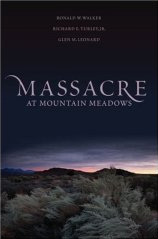
Book Review: Massacre at Mountain Meadows by Ronald W. Walker, Richard E. Turley, and Glen M. Leonard

“There is an unclean thing, born and nursed on our soil, polluting our soil, which must be driven away, not kept to destroy us.” Sophocles, Oedipus The King Act I

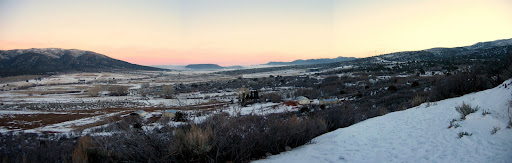
In the southwest corner of Utah, along Highway18, sits an alpine valley called the Mountain Meadows. It is a quiet place, out of the way from any major traffic. There are a few farms that sprawl across portions the valley but it is, by and large, undeveloped. At an altitude of nearly 6,000 feet the valley is a pleasant place to escape the summer heat that beats down on the surrounding dessert. In 1857 this valley was the scene of one of the most tragic events in the history of the West. That year a group of Mormon settlers disarmed a California-bound wagon train under a flag of truce and then systematically slaughtered approximately 120 men, women, and children.

For several years after the massacre fragments of clothing and the sun-bleached bones of victims lay strewn across the meadows, their shallow mass graves having been unearthed by coyotes. In southern Utah legends cropped up after the massacre about herds of wild cattle haunting the region surrounding the spot where their masters were slaughtered. Even the land itself seemed to bear a mark of guilt as a testament to the terrible crime that occurred there. In the two decades following the tragedy, natural erosion replaced the lush grasses of the meadows with scrub oak and sage, carved deep gullies across the fields, and turned the little rivulet that ran through the valley into a wide arroyo. Even the natural spring was replaced with “a sunken pool of slimy, filthy water.” Some said that this transformation was a “cu[r]se of God.” But much more pronounced than any supposed effects on the land have been the guilt and shame that have been experienced by the Latter-day Saint and local communities to this day.
Nearly one hundred years after the event Southern Utah historian and Mormon Juanita Brooks referred to the Mountain Meadows Massacre as “a ghost that will not be laid.” She continued: “Again and again, year after year, it stalks abroad to cast its shadow across some history or to haunt the pages of some novel...until it has been made the most important episode in the state [of Utah], eclipsing every achievement and staining every accomplishment.” The feelings of guilt associated with the massacre have never fully been put to rest. Mormons born many decades after the event feel pains of guilt and shame at its very mention. Collective guilt on the part of the Mormon faith has been persistently laid at the feet of its adherents by historians, novelists, and film makers ever since the event.

It has now been 150 years since the Massacre and it appears that Mormonism is finally beginning to come to some kind of terms with the event. The new book, Massacre at Mountain Meadows: An American Tragedy is a significant part of this reconciliation. This has been one the most important publications in Mormon studies in the past few years. The historical work done by the authors is first rate. The reasoning behind their conclusions is clear and transparent. Over one third of the book is citations and footnotes. This basically allows diligent readers to do their own history to check the book’s conclusions. This transparency is refreshing in any work of history but it is especially important with any work dealing with the subject of the massacre, where there is so much disagreement about even the fundamental facts concerning the tragedy.

In the book’s introduction the authors stated: “Only complete and honest evaluation of the tragedy can bring the trust necessary for lasting good will. Only then can there be catharsis.” I find the use of the term “catharsis” particularly apropos. Catharsis is the purging or cleansing of the tragic emotions. Understanding the massacre in the context of cathartic reconciliation provides an effective way to resolve the feelings of collective guilt as well as to purge the state being collectively guilty.

In 2001 the church commissioned three historians to write a history of the massacre. This history was not to be a response to prior histories but rather rely on original documents. To this end the church provided an enormous amount funding for original research. The church also wanted full disclosure of all the material that it possessed. The church opened up all of its archives for the project. These included the personal recollections that had been collected by Assistant Church Historian Andrew Jensen over one hundred years before and had up until this time been kept from the public. Perhaps most significantly, the church surrendered editorial control over the manuscript, allowing the historians to do their work without supervision.
The book has been a major hit among L.D.S. faithful. The first printing of 5,000 copies sold out before it was even released. As of November 27, 2008 (only two months after its initial release) book was already in its fifth printing, having sold more than 44,000 copies, most of them in Utah. The narrative of Massacre at Mountain Meadows proceeds like a Greek tragedy. As the authors move through the events the motivations of the perpetrators pervade the background. The book describes, in terrifying detail, how decent ordinary people were able to let themselves murder innocent men, women and children.

The institutional support for this book and it’s acceptance among mainstream Latter-day Saints shows a willingness on the part of the church and its members to come to terms with the massacre. This reconciliation is just beginning. But as Mormonism rediscovers the Mountain Meadows Massacre, its adherents are forced to confront the question of what they would have done had they been there. The difficult part of this is realizing that the perpetrators cannot simply be dismissed as evil, violent men. The perpetrators lived good decent honorable lives before the massacre, committed a terrible atrocity, and then returned to living good decent honorable lives. Anyone who sees this fact is forced to ask the question; “would I have acted any different in the circumstances?” I believe that by asking this question is the first step to healing the wounds left by the tragedy. When this question is honestly asked, we can purge whatever part of us may have caused us to do what the murderers if we had been in their situation so that we will never again repeat the tragic mistakes of our collective past.

Richard Turley, one of the co-authors Massacre at Mountain Meadows, highlighted the need for an emotional understanding and connection with the perpetrators; “and I think that those emotions that we felt are important to understanding what really happened. I think sometimes people try to tell the story of what happened at Mountain Meadows from a pedestal of righteous indignation that allows them to separate themselves form those emotions and if they never felt what happened there they don’t really understand it.” In Greek tragedy the end of the tragedy is catharsis, a cleansing or purgation of the tragic emotions of pity and fear. It is by going through the process that the tragedy evokes, that one reaches catharsis. This is not easy or always pleasant. The purpose of tragedy is to bring to the surface negative emotions so that they can then be cleansed from the spectator. Aristotle remarked: “Tragedy, then, is an imitation of an action that is serious, complete, and of a certain magnitude; in language embellished with each kind of artistic ornament, the several kinds being found in separate parts of the play; in the form of action, not of narrative; through pity and fear effecting the proper catharsis of these emotions.” C.S. Lewis likewise remarked: “Literary experience heals the wound, without undermining the privilege, of individuality.” I believe that this is because literature puts us in the position to feel and experience our shared identity with other people. By experiencing their crimes, sins, and flaws we identify whatever shared nature and, hence shared guilt, we have with others. By seeing a commonality with tragic figures we begin to understand the flawed parts of our own nature. It is then that the healing can begin. It is this process that can bring catharsis.
Monday, November 24, 2008

Book Review: People of Paradox a History of Mormon Culture by Terryl Givens

I read By the Hand of Mormon a couple of years ago and was completely drawn into it. Givens brings both a rigorous academic approach and refreshing insight to the field of Mormon studies. Not to mention the fact that he is a really good writer. People of Paradox is the perfect example of this. Givens is the Jared Diamond of Mormonism, a true polymath. He skillfully weaves the disciplines of history, philosophy, literary criticism, and theology into a seamless and compelling investigation of Mormon culture.

Perhaps the most significant aspect of this book is Givens’ characterization of Mormonism as consisting of a series of paradoxes instead of a set of fixed doctrines. This characterization is an effective way to deal with Mormonism’s non-creedal nature.

In the first part of the book Givens describes four paradoxes that he sees as essential to the Mormon experience. He then uses these four paradoxes to frame and explore the various developments in Mormon culture over the last 180 years. I thought that he would have to gerrymander the developments in Mormon culture to make them fit within these paradoxes. Instead the discussion feels natural and the relationships between the paradoxes and these events ends up being compellingly logical.

I was most interested in his history of Mormon intellectual pursuits but found all of his histories (music and dance, literature, architecture and city planning, theater, and visual arts) to be fascinating.

I could go on and on about this book but finals are approaching so I’ll get back to work.

Friday, August 15, 2008

Book Review: Legacy of Ashes; The History of The CIA by Tim Weiner

This is probably one of the most important history books to come out in recent memory though it has certainly been overshadowed by the immensely popular John Adams and Team of Rivals. Legacy of Ashes is a readable, engaging book that contains loads of information crucial to understanding twentieth century American and world history. That being said, Wiener’s biases are so patently obvious at times that he sometimes borders on silliness. However what his biases are is instantly obvious (the book is part op-ed piece) so that you can just read past them. His biases and dramatics can, in the end, be forgiven because they make the book that much more interesting and readable. Weiner combines countless firsthand interviews of the most significant figures in American intelligence with mounds of declassified documents into a compelling and disturbing narrative.

Wiener has the tendency to be a bit overdramatic. This makes for weaker history but more interesting reading. When this dramaticism combines with his biases he often makes points that are outright ridiculous. For example one of these occurs when he is discussing the CIA sabotage of the Line X espionage group. Line X was set up by the KGB as a way to steal American technological innovations; including even the Apollo Space Program. When the CIA discovered Line X they set up a complex network to systematically feed the Soviets faulty technology. The CIA even gave the KGB defective pressure monitoring software that caused a Soviet gas pipeline to explode. Weiner concludes his discussion of this program by noting on page 387: “had the tables been turned, it could have been seen as an act of terror.” Really? I guess he is trying to make the point that America considers any effort against it an act of terror. But really? The Soviets were stealing American technology so we simply sent the spies bad information. We didn’t blow that pipeline up. The Soviets did by not doing their own research and relying on what they had stolen from others.

Occasionally Weiner omits his sources where he shouldn’t, like this statement on page 412 about former director Bill Casey “After he died on May 6, at age seventy-four, his own bishop denounced him from the pulpit at his funeral, as Presidents Reagan and Nixon listened in silence.” Here is another classic example of Weiner’s dramatic (perhaps overly so) writhing style. This is absolutely fascinating. I wonder what the bishop actually said. Unfortunately, in my edition at least, there is no source or footnote as to what the bishop actually said in his funereal. The bit about Reagan and Nixon sitting in silence certainly makes for good drama but it is perhaps a bit unfair. The point that Wiener is trying to make is that much of the evil associated with Casey was really their fault and he was a sort of ‘fall guy’ for their decisions. The author condemms their silence simply from the fact that they attended his funeral (of course they sat in silence during the sermon, it would be unbelievably rude to speak up at any time). I can’t help but wonder if Carter or Ford were also there and, if so, why Weiner didn’t include them as well. I’m probably being overly critical here because he does include over 150 pages of sources and he can’t be expected to include it all. I just have the haunting suspicion that maybe the bishop’s words weren’t quite as damning as Weiner suggests.

One more criticism and then I’m done, I promise. Sometimes Weiner is a bit too harsh on the CIA’s analysis. Take for example the faulty intelligence concerning Iraq’s weapons of mass-destruction. Weiner recounts the defection of Saddam’s son-in-law who informed the agency that Saddam had destroyed his weapons of mass-destruction. Weiner states “The CIA disregarded what he said, judging it as deception. The fact that [the son-in-law] went back to Iraq and was assassinated by his father-in-law did not alter the agency’s belief.” Weiner is making the point that the CIA was blind to evidence that went against the conclusions that it had already arrived at. This point indeed has a lot of validity. But in this case it is not fair. The KGB used this tactic of assassinating and pretending to assassinate or imprison its own disinformation agents all the time in order to try and convince the CIA that these disinformation agents were genuine. It would certainly be consistent for Saddam to use this same tactic in order to convince the Agency that he had in fact destroyed his weapons of mass-destruction.

I was fascinated by Weiner’s suggestion that the CIA is becoming an “intelligence-industrial complex” alluding to the military-industrial complex warned against by Eisenhower. I hope that he will explore this idea more in a follow up book. Another interesting revelation form this book is how different the real CIA is from the one that everyone imagines. I had always assumed that the CIA was this quasi-omnipotent-omnipresent-all-knowing organization that had a good handle on world affairs. Nothing could be further from the truth. The agency was almost completely blind to anything happening inside the Soviet Union during the Cold War. In fact when the Ayatollah’s revolutionaries seized the CIA station in Tehran they were shocked by how impotent the agency had been. The radical Islamists had jus assumed that the CIA had almost complete control of Iran. But in fact the agency had only a handful of inexperienced agents with extremely limited information and almost no knowledge of the culture and language of Iran. In fact the Tehran station was so weak that the revolutionaries were offended.

Legacy of Ashes got me thinking about the fundamental paradox at the heart of the CIA (something that Weiner discusses with great insight): How do you engage in intelligence and espionage, which are absolutely dependent on secrecy and limited oversight, in a free and open society? Most of the terrible things that happened as a result of the CIA were due to this paradox. Directors lied to the presidents that oversaw them. The CIA lied to the American public. The agency constantly broke the law almost with impunity. Weiner quotes General Magruder on page 12: “Clandestine operations involve a constant breaking of all the rules…To put it baldly, such operations are necessarily extra-legal and sometimes illegal.” The core of the American democracy is the rule of law. In a democratic society all people must be subject to the law. I find it telling that the highest authority in the land is not an individual or even a body of government officials but is a law. The Constitution is the supreme authority over the U.S. Government. It is incompatible with our democratic system that officials or anyone for that matter be permitted to break the laws of our land. It is absolutely essential that the people of the nation accurately know what the government that rules them is up to in order to make sure that they are following the law. And when it comes to the CIA you have a serious problem because if the public knows what the CIA is up to the agency’s purpose is completely undermined.

This was not a problem, at least not in the same way, for the KGB. The government that they operated under was already by its nature secret. In America the public has always had a good deal of information about what its government is up to. For example the federal government as well as all state governments have freedom of information acts or public records laws. These statutes compel government officials to surrender information to any citizen that requests it with few exceptions (there are exceptions for national security reasons that do protect most of the intelligence info). Even aside from FOIA laws and the effective domestic media our government has more leaks than a colander. One of the reasons that the KGB was often more successful in espionage and intelligence than the CIA stems from the fact that KGB secrets remained secrets.

In our democracy ultimately the CIA must be accountable to the American people. This is virtually impossible to do with out compromising all legitimate missions the CIA is caring out. I can quickly get the names and contact information on just about any government official. If it were this easy to do this with the members of the intelligence community they would all be killed. Furthermore, the American people may not fully understand the reasons for certain operations that may on the face seem expensive, pointless, futile, or even abhorrent. The apparent answer to this is that you have elected officials do the monitoring. But these same problems exist with elected officials. Furthermore, these elected officials can not be held accountable for their oversight of covert operations if these operations remain secret from the public. Where do you draw the line? Certainly you can’t have the CIA meddling around the world as if it were a toy with zero accountability. But in order to have accountability you must have accurate knowledge. But if knowledge of intelligence activities is widespread they losses all effectiveness. In essence; intelligence ceases to be intelligence.

Sunday, July 13, 2008

Something cool to waste your time on

Campaign finance disclosure laws require that anyone making donations of $100 or more must make their name and donation history a matter of public record.
This website lets you track campaign donors via these records. You can search by you neighborhood, you can see who celebrities and companies are donating to, and you can even check up on your friends (a little disturbing but also extremely interesting). I’ve added the widget below or you can go to the website.


This is a somewhat frightening example of the power that comes from combining the internet with freedom of information acts.

Also I’m a confessed ‘mapophile.’ I’m just fascinated by maps. There is this website with some cool interactive maps that show historic trends and wars here’s the one for the spread of religions.